Competition
Rewards: Neighborhood Disaster Equipment Modular Emergency Needs Units Design – Student Project Competition - Equivalent Reward
(TR: Mahalle Afet Donatıları Modüler Acil İhtiyaç Üniteleri Tasarımı - Öğrenci Proje Yarışması - 5 birincilik eş değer ödülünden biri)
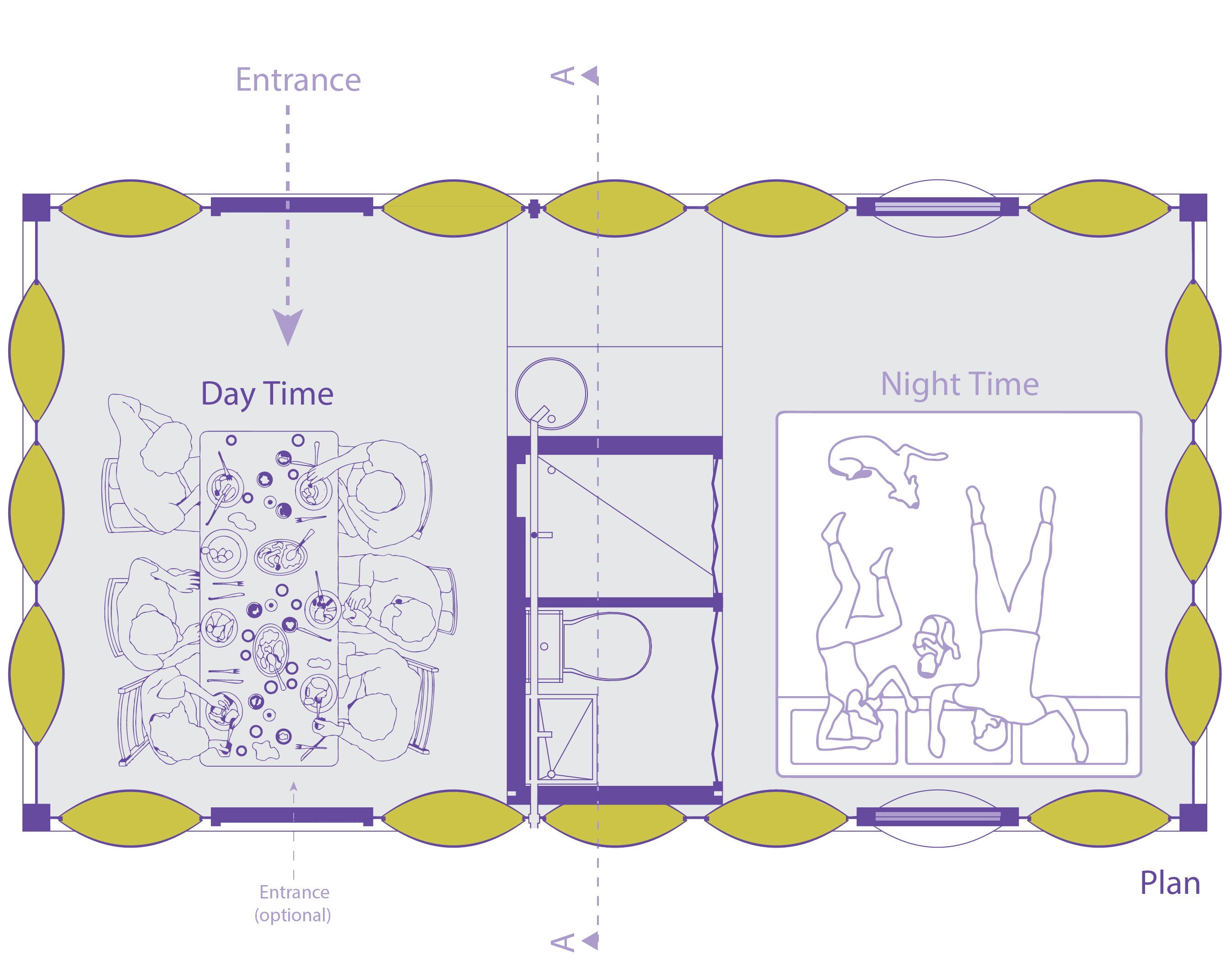
Pillowcase is a container prioritized for earthquakes while also addressing fire and disaster situations. It consists of a foldable steel skeleton and fabric walls that are shaped by being filled with materials from the surrounding area. When folded, the volume it occupies is reduced by approximately 72%. Its minimum occupied volume is approximately 23 m³ and its maximum occupied volume is approximately 81 m³, and when fully opened a single module provides approximately 23 m² of area.
The foldable steel skeleton has folding points designed similarly to the corrugated section of a drinking straw. In this way, it is installed simply by folding and unfolding.
There are 3 roof pieces. Each roof consists of 2 panels. By utilizing the accordion element between them, the upper panel opens at a slight angle. The roofs are inclined so that sunlight falls on the solar panels more efficiently. The two side roofs rise from the floor during installation and are fixed in place. The middle roof is fixed on top of the wet-core volume. In the event that the wet core is dismantled, it is transported with the support of the two adjacent roofs.
The fabric used in the structure consists of layers; these layers can be separated and sent for recycling, or for permanent situations concrete can be poured into them and they can be used as formwork and transformed into elements such as urban furniture or ground elements. The fabric system is organized from the outermost layer inward as follows: The outermost layer is a filter layer that captures ash and dust particles; this layer reduces the transfer of dirt into the main system. Directly beneath it is the outer hemp fabric shell, designed for UV resistance and a second life. This layer is both the visible surface of the structure and can later be cut and transformed into clothing or home textiles.
Under the outer shell there is a structural mesh / load distribution strip to prevent the load from being transferred to the seams; this layer both distributes the weight and defines the form and folding lines of the module. Directly inside this is a protective separator layer that reduces friction and provides protection between the outer textile and the inner system.
At the innermost level is the multi-cell TPU inner chamber, which is the main structural component carrying the system; this layer retains the filling materials in a controlled manner through a single inlet-outlet and, thanks to its cellular structure, creates a bulging form. Finally, there is the filling material that determines the mass and function of the system; this may be water, sand, gravel, soil, or grain and provides the structure with both weight and thermal and structural stability.
When the fabric is not filled, it can be used for various purposes such as a shade structure, hammock, tent, and similar functions.
If desired, the structure includes a removable wet core containing a toilet and kitchen. In this volume, a greywater system is used so that the water used in the shower is filtered in the toilet tank and reused as flushing water.
In the middle part of the floor, inflatable rings are positioned so that the structure can float in wetland areas and are inflated when needed. By reducing or completely emptying the filling material within the walls of the structure, the structure is enabled to float. At the same time, the fabric chamber positioned in the central void of the floor can be filled with materials such as sand or soil, allowing it to take the shape of uneven, sloped, sandy, shifting, or otherwise difficult ground conditions and sit stably; the fabric used in this system is designed as a multilayer textile sandwich.
The purpose of having various ground conditions is to enable settlement on rubble or water in cities such as Istanbul where there is no available open space; and to enable installation on sand at the beach or on rocky terrain during fires in places such as Antalya.
Since the walls of the structure are removable or foldable, multiple modules can be combined side by side to obtain larger enclosed spaces, or different interior layouts can be created according to needs.
It is also intended that fabrics can be attached to the rails on the ceiling and filled with materials such as water or grain so that the entire module volume can be used as storage.
Designed by İdil Can
[TR]
Pillow case deprem öncelikli olup yangın afet durumuna da hitap eden bir konteynerdir. Katlandığında kapladığı hacmi yaklaşık %72 kadar küçülen çelik istekeletli ve içi etraftaki malzemelerle doldurularak şekil verilen kumaş duvarlardan oluşur.En fazla kapladığı hacim yaklaşık 23 m3 en fazla kapladığı hacim ise yaklaşık 81 m3 olup tam açıldığında tek bir modül yaklaşık 23 m2 alan sağlar.
Katlanabilir çelik iskelette tıpkı bir pipetin tırtıklı yeri gibi tasarlanmış katlanma noktaları bulunur.Bu şekilde sadece katlanıp açılarak kurulur.
3 parça çatı vardır.Çatıların her biri 2 plakadan oluşur.Aralarındaki akordeon elemanından yararlanarak üstteki plaka hafif eğimle açılanır.Çatılara eğim verilerek solar panele güneş açısını daha verimli düşmesi hedeflenmiştir.Yandaki iki çatı,kurulumda döşemeden yukarı kalkar ve sabitlenir.Ortadaki çatı ise ıslak hacim kütlesinin tepesinde sabittir.Islak hacimin demonte olması durumunda yanındaki iki çatıdan destek alarak taşınır.
Yapıda kullanılan kumaş katmanlardan oluşur bu katmanlar ayrıştırılarak geri dönüşüme aktarılır veya kalıcı durumlar için içerisine beton dökülüp kalıp olarak kullanılarak kent mobilyası,zemin elemanı gibi elemanlara dönüşebilir.Kumaş sistemi en dıştan içe doğru şöyle kurgulanır:En dışta kül ve toz partiküllerini tutan filtre katmanı bulunur; bu katman ana sisteme kir taşınmasını azaltır. Onun hemen altında,UV dayanımı ve ikinci yaşam için tasarlanmış dış kenevir kumaş kabuk yer alır.Bu katman hem yapının görünen yüzeyidir hem de ileride kesilerek kıyafet veya ev tekstiline dönüştürülebilir.
Dış kabuğun altında yükü dikişlere bindirmemek için yapısal ağ / yük dağıtım şeridi bulunur; bu katman hem ağırlığı dağıtır hem de modülün formunu ve katlanma hatlarını tanımlar. Bunun hemen içinde, sürtünmeyi azaltan ve dış tekstil ile iç sistem arasında koruma sağlayan koruyucu ayırıcı katman yer alır.
En içte ise sistemi taşıyan ana yapı olan çok hücreli TPU iç hazne bulunur; bu katman dolgu malzemelerini tek giriş-çıkış üzerinden kontrollü şekilde tutar ve hücreli yapısı sayesinde bombe formu oluşturur. En son olarak da sistemin kütlesini ve işlevini belirleyen dolgu malzemesi yer alır; bu su, kum, çakıl, toprak veya tahıl olabilir ve yapıya hem ağırlık hem de termal ve yapısal stabilite sağlar.
Kumaş doldurulmadığında ise gölgelik,hamak,çadır ve benzeri çeşitli amaçlarda kullanılabilir.
Yapıda istenilirse demonte edilebilinen tuvalet ve mutfağı içeren ıslak hacim bulunur.Bu hacimde gri su sistemi kullanılarak duşta kullanılan su klozet haznesinde filterelenerek tekrardan sifon suyu kullanılır.
Döşemenin orta kısmı sulak alanda yapının yüzmesi için simitler konumlanır ihtiyaç halinde şişirilir.Yapının duvarlarında bulunan dolgu malzemesi azaltıp veya tamamen boşaltılarak yapının yüzmesini sağlar.Aynı zamanda döşemede ortada yer alan
boşluk konumlanış kumaş hazne de kum, toprak gibi malzemelerle doldurularak engebeli,eğimli,kum gibi kayan veya yapının oturması zor zeminlerin şeklini alarak sabit oturmasını sağlar;bu sistemde kullanılan kumaş ise çok katmanlı bir tekstil sandviçi olarak kurgulanır.
Zeminin çeşitli olmasındaki amaç İstabul gibi boşluğun olmadığı şehirlerde molozların üstüne veya suya yerleşim sağlayabilme;Antalya gibi yangın anında sahilde kuma kurulum veya kayalık alana kurulumu sağlayabilme amaçlanmıştır.
Yapıdaki duvarlar sökülebilir veya katlanabilir yapıda olduğu için birden fazla modül yan yana gelerek daha büyük kapalı hacimler elde edilebilir veya iç mekanda farklı planlar ihtiyaca göre oluşturulabilir.
Tavanda bulunan raylara da kumaşların takılarak içlerini su,tahıl gibi dolgularla doldurularak tüm modül hacmini depo olarak kullanılması amaçlanmıştır.
Tasarım: İdil Can